One reason it took me such a long time to finish college--or for college to be finished with me--was that I couldn't seem to focus on my requirements. I was supposed to be a "Communication Studies" major(my idea of a practical use for my writing obsession). But every semester, the listings in the English department called my name. What choice did I have but to answer, to follow, to extend my stay at the university just a little longer?
Then there were the dance classes--at least one each semester. I must have been the klutziest student in ballet. Invariably, when the class moved one way, I drifted in the opposite direction. (A metaphor for my life, maybe?) But that didn't keep me from taking the beginner's class again and again, enjoying the feeling of being regal, disciplined, graceful--if only in my mind.
I was also drawn to languages. Each felt like a personal invitation to travel in a way that even I could afford. I immersed myself in Italian and French, and even tried Chinese--though it rapidly proved too demanding for an uncommitted dilettante who was looking for a trap door to the culture. Eventually, I found that door, as well as many interesting friendships, in the Asian Studies department. Meanwhile, my adviser wanted to know if I had satisfied my science requirement yet. Um, maybe next semester? I said sheepishly.
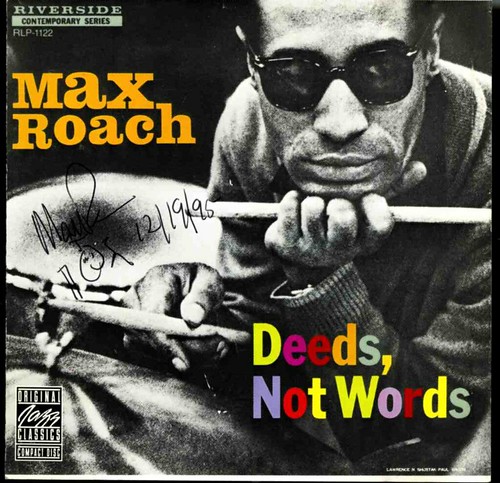
However, when I heard that music giant, Max Roach was teaching his first course in "The History of Jazz," I scratched Zoology 101 from my schedule. Honestly, I didn't expect to be admitted. I figured the class would be overrun by music majors, and I'd still have time to sneak into Botany or Astronomy at the last minute.
But to my surprise, only twenty students signed up to spend a semester with a legend; and to my eternal good fortune, I was one of them. The class turned out to be one of the most memorable experiences of my excessively varied and academically checkered college career.
Every Tuesday and Thursday afternoon at 2:20, we sat in a little room and listened to Max talk about jazz. He also talked about his life, which it turned out, was pretty much the same thing. Nearly every one of the musicians whose music streamed into the hallway, cajoling us inside with the wild notes from their saxophones or the rhythms of Max's drums, and altering the atmosphere of the University in subtle and not so subtle ways was someone he knew, someone he'd played with or learned from, or watched come up.
I can see him now--a trim man in his fifties, always in a well-tailored suit--leaning against the desk, as he turned the history of America's original art form into a personal story, one filled with humor and excitement and vibrant life--but also great tragedy. When he talked about the death of Charlie Parker, there were not only tears in his eyes, they glistened in the eyes of every student in the class.
But Max's class was not just a History of Jazz; it was a history of African Americans in the twentieth century. He told us about playing in hotels where he wasn't allowed to stay; and of the many composers who'd sold their music for almost nothing, only to see white musicians become wealthy by recording it. There was no bitterness in Max's telling of the past he'd lived, but there was no sugarcoating it either. Change had come, but there had been a long, hard price for it. It needed to be spoken about. It needed to be remembered.
An iconoclastic musician, Max was a rule-breaker in the classroom as well. He failed to show up for class if he had something else to do--though he usually sent another musician in his place. When mid-terms came around, he announced the first exam. Immediately, the class was seized with the usual anxiety. What would be covered? Would we have to identify the music we heard? We didn't even have a text book; nor had most of us taken notes. How could we prepare?
After the third question, Max held up his hand like a stop sign. "Have any of you heard a word I said all semester?"
We must have presented a uniform face to him--stunned and perplexed. Was he about to reveal something that was going to be on the exam? Something we'd obviously missed?
He shook his head sadly. "What I've been trying to teach you is just one thing: you don't have time to worry about stuff like that. None of us have time."
He seemed disappointed with us in some way and dismissed the class early that day. The next time it met, he announced that he'd changed his mind. There would be no exams that semester. There was some vague talk about assigning a paper, but that never materialized either. In the end, I got an A in the class, and I suspect everyone else did, too. Like the music he played for us weekly, and the stories he shared, the grade was Max's free gift.
This week, when I heard my former teacher had died at eighty-three in Manhattan, I thought about the hours I spent in his classroom, and remembered his exhortation about the limits of time. Of course, he was right. Both teacher and students have been buffeted and exalted by the years that separated us. The A has disappeared on a meaningless yellowed transcript. But the music he played for us, those old recordings that snaked under the door and down the hallway, drawing us deep into a world he inhabited and helped to create--that is with me still.
Thank you, Max.


36 comments:
Oh my gosh, I can't believe you took ballet lessons (I hope you had taken them as a child) -- I started "adult beginning ballet" when I was over forty and took group classes and private lessons for about two years. I knew that the best I could achieve would be to learn to stand properly and do some of the barre exercises reasonably well, but it was so important for me because it was the first time I ever decided to do something I knew I would not be good at. It was one of the best things I ever did :)
lisa: The freedom to do something you're not good at--just for the joy of it--has got to be one of the greatest gifts we can ever give ourselves.
Patry, your advice to Lisa is priceless. I'm going to print it out and paste it up as a reminder as to how I should live the rest of my life.
such a nice tribute to max. thanks for sharing those pieces of your life with us. :-)
A lovely tribute and memory. I think it took a lot of wisdom to forego the requirement path and take classes that really do increase the depth and breadth of the individual. Your story reminds me of the summer class I took in college that was taught by Shirley Chisholm. The experience she brought to the classroom was priceless.
I too, avoided the sciences, thinking them too hard, too much math. Until I did my nursing requirements on my second stab at college, all at once in a big hard lump. Beat my timidity out of me.
Still, what a better choice you made, Max over some dinky zoology course. A boddhisatva over an irrelevant requirement. Time enough for that later.
amishlaw: Letting go of judgment--both my own and others' is the best parts of growing older. I'm not surprised you agree!
sky: You would have loved it...good to see you here.
Robin: I loved my non-traditional college years though the high cost of education probably prohibits that approach now. Meanwhile, I'd love to hear/read more about your class with Shirley Chishom!
zhoen: I ended up taking two semesters of anatomy, which I loved, one of astronomy (not so much) and a biology course taught by an excellent professor who knew how to make it relevent. It really does demand a different kind of thinking--which is, of course, what the university experience is all about. In other words, I complained about the science requirement, but I'm glad they existed.
Wonderful post!
Patry, this is a beautiful tribute. The other night when I commented, only the first paragraph of your post was there! There was a piece on Max Roach in the Denver Post this morning and I thought of you and I'm glad I came back to read the rest of this. I suppose I've subscribed to his advice on and off for most of my life, but try to live it every day now. Years ago, I took many courses that sounded interesting but didn't get me any closer to completing my degree, mainly art history courses -- of course I never did get that degree in Electrical Engineering :)
An amazing story, Patry...what a beautiful experience, to take his class! I love how teachers can make such a profound and lasting impact on their students when they do it right.
Love,
D.
Oh, Patry, how envious I am that you got to spend two afternoons a week listening to Max tell it like it is! :) We've lost another giant. I just hope people have some inkling of the huge gifts he gave to the world of jazz...and to the world.
I've got goosebumps up and down my arms in 80 degree August weather. What a rare opportunity you had sitting in his class. Wish I had been number 13.
Now those are the words and actions of a true teacher. Your story gave me shivers. He sounds like he was a truly incredible man.
What a lovely tribute... thanks for sharing the memories.
Wow Patry! What a great experience to study with Max Roach. I only saw him play once. Emeryville, CA in 1991. My son was with me. At that time there was a little controversy about whether or not he should have played with some hip-hop musicians. As I recall Wynton Marselis was arguing for the negative. In any event he was playing with his quartet(Odean Pope on tenor, Cecial Bridgewater on trumpet and Tyrone Brown on bass)He was an an innovator and a class act!
As usual Patry, your life stories reach out and touch a cord. I agree with amishlaw, the little truth you laid out for lisa has the feel of real wisdom...learned I'm sure the hard way.
Thanks for the allowing me to share this bit of your life.
That man certainly knew how to teach. What a gift to you and those other students in the class.
Thanks for sharing this tribute, and the good advice!
rdl, dave: Thanks for reading...
lisa: Interesting that art history drew you. Given the man you married, that may have served you far better than electrical engineering! p.s. Thanks for returning to read the full piece. Blogger has been giving me a lot of trouble lately...
delia: I try to remind myself that we ALL teach something and we all make an impact...but of course, far too often, I forget.
marilyn: It's been great to read all the tributes about him. THey make me believe that a lot of people did know...
colleen: You would have loved it, but then again, you were off somewhere loving your own corner of the world. (Does that make sense?)
jessie: When he refused to teach--at least in the traditional sense--he taught us best. I suppose it wouldn't work for everyone, but it worked for him. Thanks for visiting!
sue: THanks for stopping by to share my memories.
fred: I read a little bit about the
controversy Matt started with what some viewed as an "impure" attitude toward his music. But I can imagine him wanting to engage the young where they were, not forcing them to be where he was. That must have been a very fine concert you and your son saw.
gary: Oh yes, the hard way every time, but frequently it's also the more interesting way. Thanks for reading.
becca: He often said he didn't know how to teach, and that he couldn't relate to the institution that employed him. However, he kept at it. Obviously, the legion of students who have their own memories of afternoons with Max convinced him otherwise.
I'm sure Max would have been delighted with this (or is, depending on your beliefs). I knew nothing about him, but have come across several eulogies recently. What a privilege to have learned directly from him. Thanks for sharing your impressions and some of what you learned, Patry.
A good teacher teaches even outside the reach of his lifetime. How lovely to honor him by keeping his lessons spreading.
Pohanginapete: So great to see you back in the blog circuit again!
pearl: An interesting thought--and quite true. Perhaps the teaching is even distilled and purified by the final absence of the teacher. One can only hope...
Wonderful tribute and a wonderful experience. If only all teachers could reach beyond the wrote of lesson and make learning live.
beautiful, simply beautiful. what great memories of this man. His advice to the class - wow! We DON"T have time for this! Your words to lisa: this is what I appreciate most about getting older. I do what I want for the sheer pleasure it brings. A great gift, indeed.
Thanks, Patry, for this tribute! Another classic for your collection. :) Thanks also to Lisa for referring to the Denver Post article, which I just read and printed out. My husband is a Miles and Mingus fan and I'm curious to see if any of his CDs also feature Max.
I'm with you on the fun courses and wish I'd taken many more....
I hope blogger lets me post this time -
What an amazing experience that class must have been!
I was sad to read about his passing. I'm glad he lived long enough to see some appreciation of his music in his own time, and to see some improvements in civil rights/society's attitude. Though no matter how old a great person lives to be, it never seems like its long enough, does it?
((hug))
What an amazing story; as much as I hate to hear of the passing of a giant in any particular field, I do find that it gives folks the opportunity to share some amazing stories/memories they have of that person. What you've shared says just as much, if not more, about the quality person that Max was, but it's from a very personal perspective. Thanks so much for sharing it with us.
wow
what a wonderful tribute
you are so lucky to have known the man and shared his thoughts on jazz and life
i feel a little green
(and blue)
thanks to you both :)
I often look at the teachers I had in university and wonder whether I was worthy of their greatness. It wasn't until much later on that I appreciated the gifts they so unselfishly shared with us in their classroom.
In my case, it was journalism, but the essence of your experience rang so true to me. For years, some of my strongest columns were those that touched on these people, on that time in my life. I wish there were some way to let them know how deeply resonant their temporary influences were on my life.
There is (hopefully) always one teacher who stays with us through out our life. Always there in the back room of our mind.
What a wonderful experience and beautiful tribute to a man who lived his art. Thanks for sharing, Patry. xx, JP/deb
That's incredible. What a gem to have such a man to glean wisdom from. And what he says is so true. There is too little time to be worrying about perfection - the perfection is in the gaps and slips. Just being free to enjoy the moment - I wish I could remember that all the time instead of only occasionally.
easy: "make learning live"--amen.
taradharma: the scarcity of time is one lesson we never seem to get enough of.
tinker: your final sentence says it all...
matt: From what I've read, he was no saint, but he was unfailingly kind, stimulating, and generous in our classroom. What more can we ask of our teachers?
carmi: I guess we can only hope that the giving was its own reward.
herhimnbryn: the older I get the more crowded "the back room of my mind" grows. Great phrase.
lara berch: Thank you so much for your interest in my much neglected blog. I haven't updated my links in quite some time, but when I do, I will definitely look at your site.
deborah: Always good to see you here...Thank you!
chiefbiscuit: Oh, that's the trick isn't it? Not just recognizing the truth when you see it, but holding it in your mind on a daily, hourly basis. If you figure out how to do it, let me know!
how cool is that?
How wonderful that you had Max Roach as a teacher! I saw him play once in NYC in the West Village in the early 90's. Watching him play felt sacred somehow.
His presence onstage sounds a lot like his presence in your class. I enjoyed reading this and having these memories come back.
Tara: Paris is a great city for jazz.
David: VERY!
kg: You saw him in his element. The classroom--at least, that first year--was not that for him. And yet, he was a man who knew how to be at home in the world--and communicated that.
Post a Comment